


Dependents’ Educational Assistance (DEA)/Chapter 35 Benefits Explained
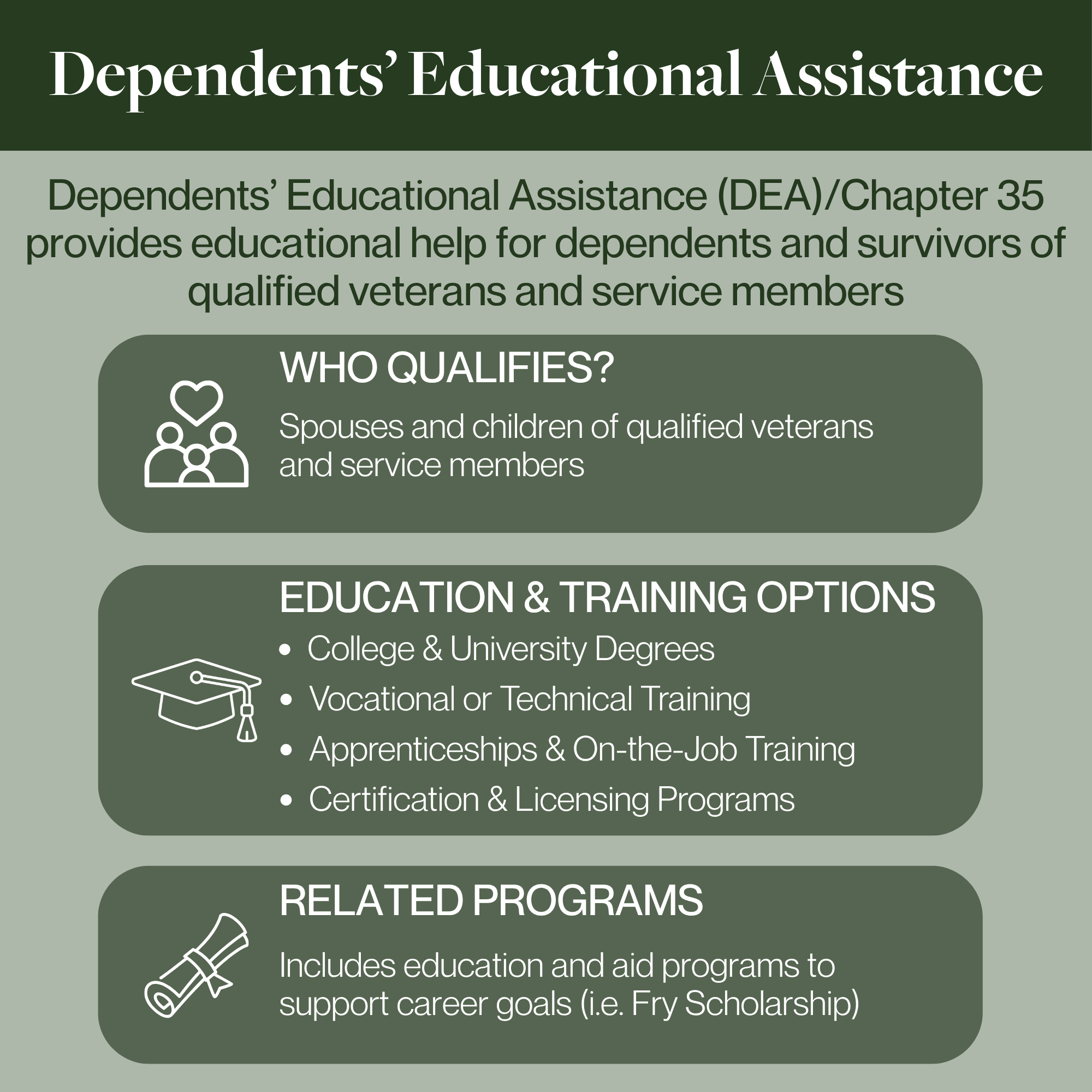
Dependents’ Educational Assistance (DEA), also known as Chapter 35 benefits, is a VA education program that provides financial support for schooling and training to eligible dependents of certain veterans. DEA benefits are most commonly available to spouses and children of veterans who are permanently and totally disabled due to service-connected conditions or who died as a result of service.
Because DEA eligibility is tied to a veteran’s disability status or cause of death—and subject to specific timing and usage rules—understanding how and when these benefits apply is critical for families seeking to use them.
DEA (Chapter 35) provides education benefits to eligible spouses and children of veterans who are permanently and totally disabled or deceased due to service-connected conditions.
Eligibility is most commonly triggered by a veteran being awarded Permanent and Total (P&T) status or by entitlement to Dependency and Indemnity Compensation (DIC).
Important to Know: DEA benefits have strict time limits for use, and missing those deadlines can result in loss of benefits.
Bottom Line Up Front:
College or university degrees
Vocational or technical training
Apprenticeships and on-the-job training
Certification and licensing programs
DEA is governed by 38 U.S.C. Chapter 35 and provides monthly education benefits to eligible dependents for approved programs such as:
What is Dependents’ Educational Assistance (DEA)?
DEA is not based on financial need. Instead, eligibility depends on the veteran’s service-connected disability status or cause of death.
Who is Eligible for DEA?
Spouses
Is rated permanently and totally disabled due to service-connected conditions, or
Died as a result of a service-connected disability, or
Died while permanently and totally disabled
A spouse may qualify if the veteran:
Spouses may also qualify in certain cases involving missing, captured, or detained service members.
Children
A child may qualify if the veteran meets the criteria above.
Eligibility is generally structured as follows:
Benefits typically begin at age 18 or upon completion of high school
Children generally have an 8-year period of eligibility to use DEA benefits
In some cases, the eligibility period may be extended based on specific circumstances
When Does DEA Eligibility Begin?
DEA eligibility is typically triggered by one of the following:
A VA decision granting Permanent and Total (P&T) disability status
A VA decision granting service connection for cause of death
A finding that the veteran was permanently and totally disabled at the time of death
In many cases, DEA eligibility is awarded automatically when VA grants P&T status. For a detailed discussion of Permanent and Total Status, please click here.
How Long Do You Have to Use DEA Benefits?
DEA benefits are subject to strict time limits.
If based on P&T: generally 10 years from the date of eligibility
If based on a veteran’s death: generally 10 years from the date of death or VA decision
For Spouses:
Benefits generally begin at age 18 or upon completion of high school
Children typically have an 8-year period of eligibility to use benefits
Extensions may apply in certain circumstances
Some spouses may qualify for extended or modified eligibility periods depending on when the qualifying event occurred.
For Children:
Evidence That Matters in DEA Claims
DEA eligibility is generally determined based on the veteran’s VA disability status, but documentation may still be required.
VA rating decisions showing P&T status
Death certificates, in certain cases
VA decisions establishing service connection for cause of death
Proof of relationship (marriage or birth records)
Key Evidence Includes:
Because DEA is derivative of the veteran’s benefits, errors in the underlying VA decision can directly impact eligibility.
What If VA Says a Dependent Is Not Eligible for DEA?
If VA determines that a dependent is not eligible for DEA, the issue is often tied to the underlying VA decision (such as P&T status or cause of death).
Supplemental Claim (with new and relevant evidence)
Higher-Level Review
Board of Veterans’ Appeals
Those decisions may be challenged through:
Because DEA eligibility is based on these underlying determinations, successfully appealing them may establish entitlement to DEA benefits.
DEA benefits are closely tied to a veteran’s disability status and VA’s legal determinations. Errors in those decisions can prevent families from accessing important educational benefits.
Here at Greene & Marusak, we are happy to answer general questions and help you understand how DEA eligibility may relate to a veteran’s underlying VA benefits.
Contact us today to speak with an experienced VA-accredited claims agent or attorney.