


Total Disability Rating Based on Individual Unemployability (TDIU) Explained
Total Disability based on Individual Unemployability (TDIU) is a VA benefit that allows veterans to be compensated at the 100 percent disability rate when their service-connected disabilities prevent them from working—even if their combined disability rating is less than 100 percent. Because TDIU focuses on a veteran’s ability to function in a work setting, these claims often require detailed medical and vocational evidence.
TDIU is granted when a veteran’s service-connected disabilities prevent them from securing or maintaining substantially gainful employment.
Substantially gainful employment generally means work that provides income above the federal poverty threshold for one individual.
Important to Know: TDIU can be awarded even if a veteran does not meet the standard combined rating requirements, depending on the severity of their disabilities and impact on employment.
Bottom Line Up Front:
TDIU is governed by 38 C.F.R. § 4.16 and provides compensation at the 100-percent pay rate when a veteran is unable to maintain substantially gainful employment due to service-connected disabilities.
What is TDIU?
VA recognizes two primary paths to TDIU:
One service-connected disability rated at least 60 percent, or
Multiple service-connected disabilities with a combined rating of at least 70 percent, with at least one disability rated at 40 percent or higher
A veteran may qualify if they have:
Schedular TDIU (38 C.F.R. § 4.16(a))
Disabilities affecting a single body system (e.g., orthopedic conditions)
Disabilities resulting from a common etiology or single incident
Disabilities affecting one or both upper or lower extremities
Multiple injuries incurred in action
Multiple disabilities incurred as a prisoner of war (POW)
For purposes of meeting the “single disability” requirement, VA may combine certain conditions and treat them as one disability, including:
Even if a veteran does not meet the percentage thresholds above, VA may still grant TDIU if the evidence shows the veteran is unable to secure or follow substantially gainful employment due to service-connected disabilities.
Extraschedular TDIU (38 C.F.R. § 4.16(b))
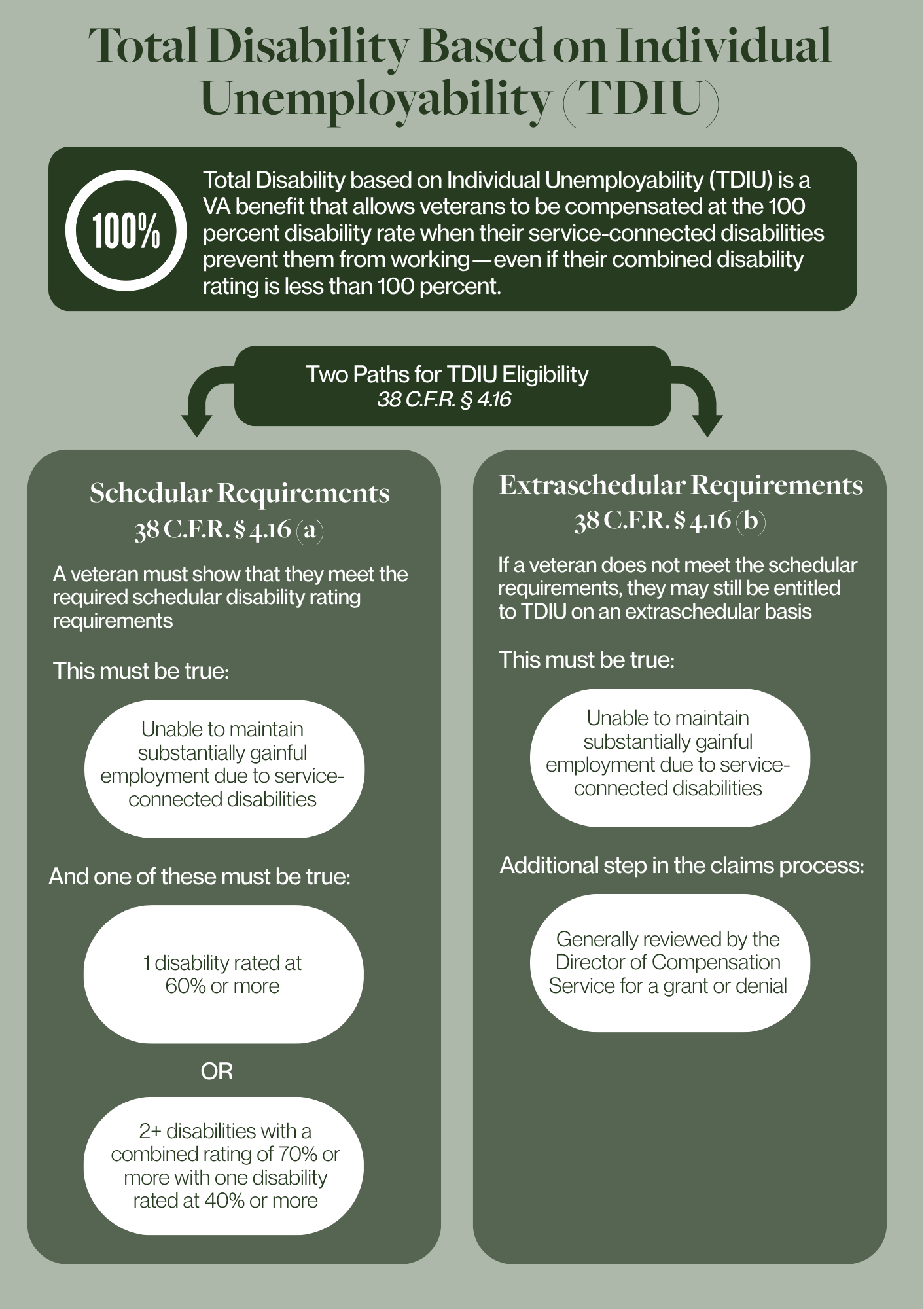
The central question in a TDIU claim is whether the veteran can perform substantially gainful employment—not just whether they can return to a prior job.
How VA Evaluates TDIU Claims
The functional limitations caused by service-connected disabilities
The veteran’s education, training, and work history
Whether the veteran can realistically perform and sustain work
VA must consider:
VA cannot consider:
The veteran’s age
Non-service-connected disabilities
Evidence That Matters Most in TDIU
VA Form 21-8940 (Veteran’s Application for Increased Compensation Based on Unemployability)
VA Form 21-4192 (Request for Employment Information)
VA Forms
Medical and Vocational Evidence
Medical records documenting functional limitations
Vocational expert opinions addressing the veteran’s ability to work
Opinions linking service-connected disabilities to unemployability
Statements from the veteran, family members, or coworkers describing how disabilities impact daily functioning and the ability to work
Reports of missed work, reduced productivity, or job loss due to service-connected conditions
Lay Evidence
Strong evidence often focuses on how symptoms translate into real-world work limitations.
How to Appeal a Denied TDIU Claim
Supplemental Claim (with new and relevant evidence)
Higher-Level Review
Board of Veterans’ Appeals
If VA denies entitlement to TDIU, veterans may appeal through:
Because TDIU claims involve detailed analysis of medical evidence, vocational limitations, and VA regulations, professional representation can significantly improve outcomes.
Looking for More Information?
Check out our YouTube video where VA-Accredited Attorney, Jon Greene, and VA-Accredited Claims Agents, Vittoria Marini and John Kent, sit down to discuss everything veterans need to know about TDIU.
Denied TDIU or Unsure If You Qualify? Call Greene & Marusak LLC
TDIU claims are among the most complex areas of VA law. Veterans are often denied because VA fails to fully consider how their disabilities impact their ability to work.
If VA denied your TDIU claim—or you are unsure whether you qualify—Greene & Marusak LLC can review your case and explain your options.
Contact us for a free case evaluation today to speak with an experienced VA-accredited claims agent or attorney.