

VA Rating Criteria for Knee Disabilities Explained

When VA grants service connection for a knee condition, disability ratings are assigned based on multiple factors, including range of motion, instability, pain, functional loss, and flare-ups. The rating can be assigned based on one or multiple of these factors, and more than one rating may be assigned for the same knee if symptoms are distinct and do not overlap. The rating or ratings assigned determine a veteran’s monthly compensation and eligibility for additional benefits. Because knee conditions can fluctuate due to weather or flare-ups, and often worsen over time, it is important to provide VA with documentation of the true severity of symptoms.
VA rates knee disabilities under 38 C.F.R. § 4.71a using diagnostic codes that evaluate limitation of motion, instability, cartilage damage, ankylosis, and functional loss due to pain. Ratings commonly range from 0 to 60 percent, and separate ratings may be assigned for different knee symptoms.
A veteran’s lay statements, treatment records, range of motion testing, and compensation and pension (C&P) examinations are important forms of evidence when seeking higher ratings for knee conditions.
Veterans with severe knee disabilities may qualify for Total Disability Based on Individual Unemployability (TDIU).
Bottom Line Up Front:
How VA Rates Knee Disabilities (38 C.F.R. § 4.71a)
VA assigns ratings based on specific diagnostic codes, and multiple ratings may be assigned for the same knee under different diagnostic codes for distinct symptoms.
Ratings may also be assigned under other diagnostic codes based on residual weakness, pain, or limitation of motion.
Limitation of Flexion and Extension
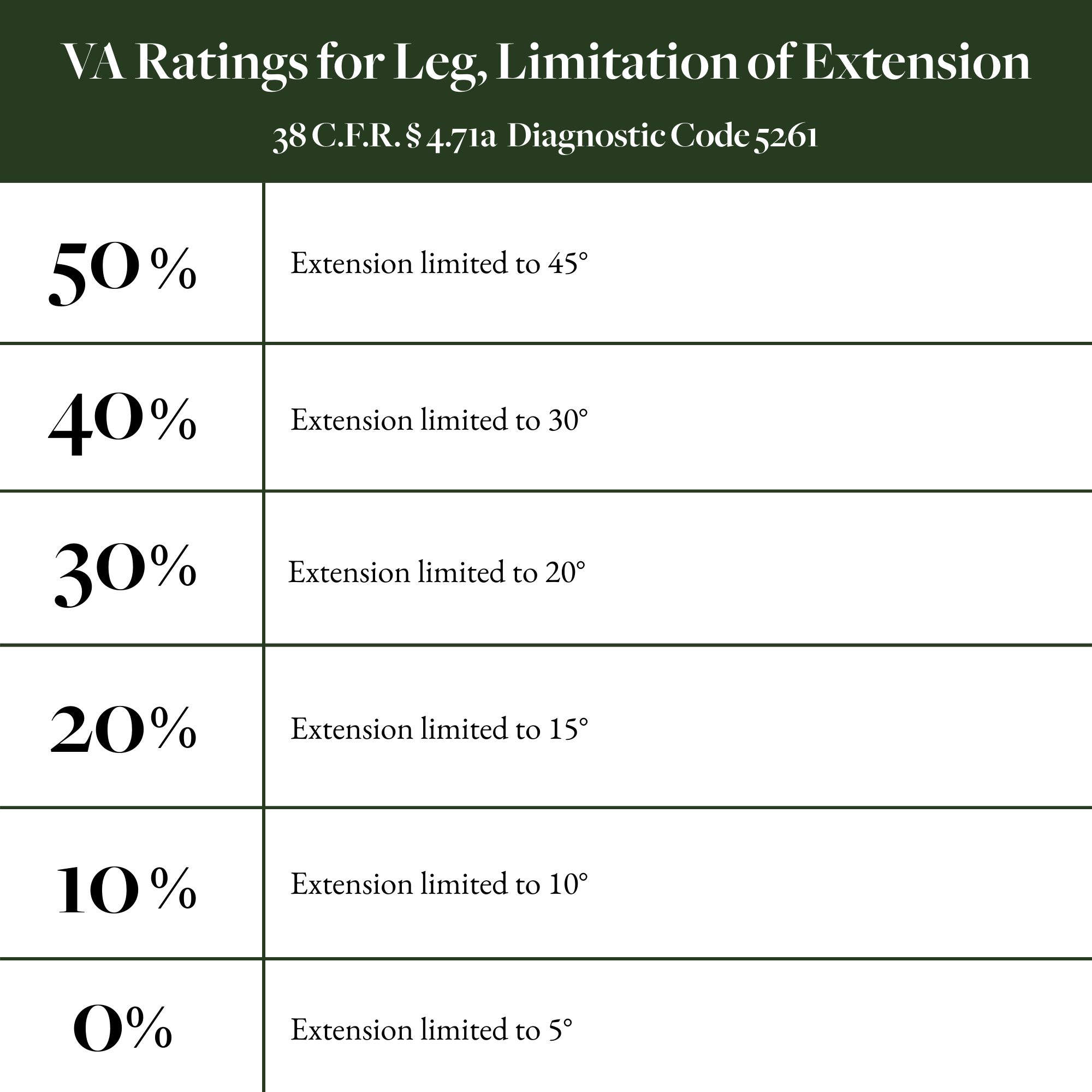
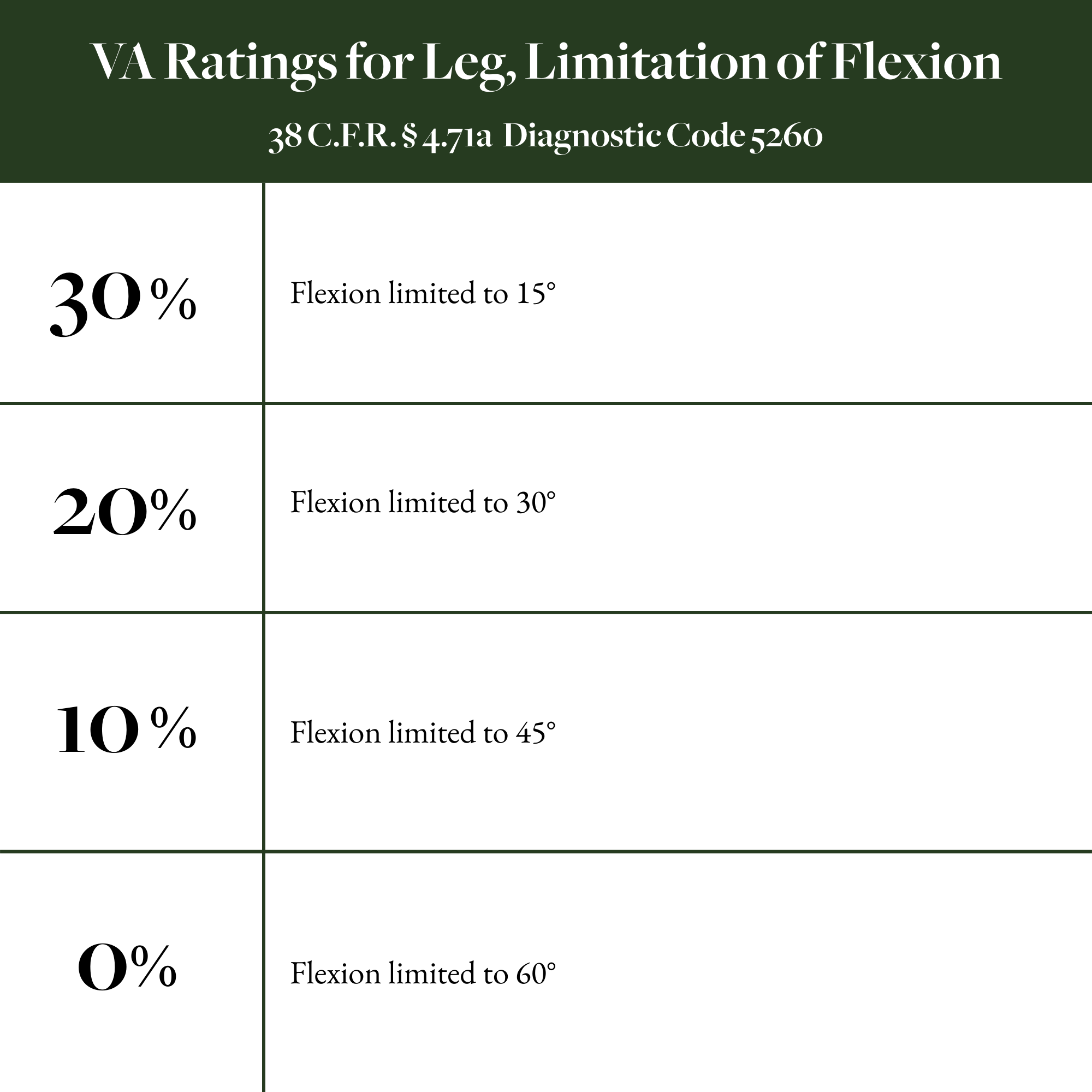
Rated under diagnostic codes 5260 and 5261. Ratings for limitation of flexion range from 0 to 30 percent, and ratings for limitation of extension range from 0 to 50 percent.
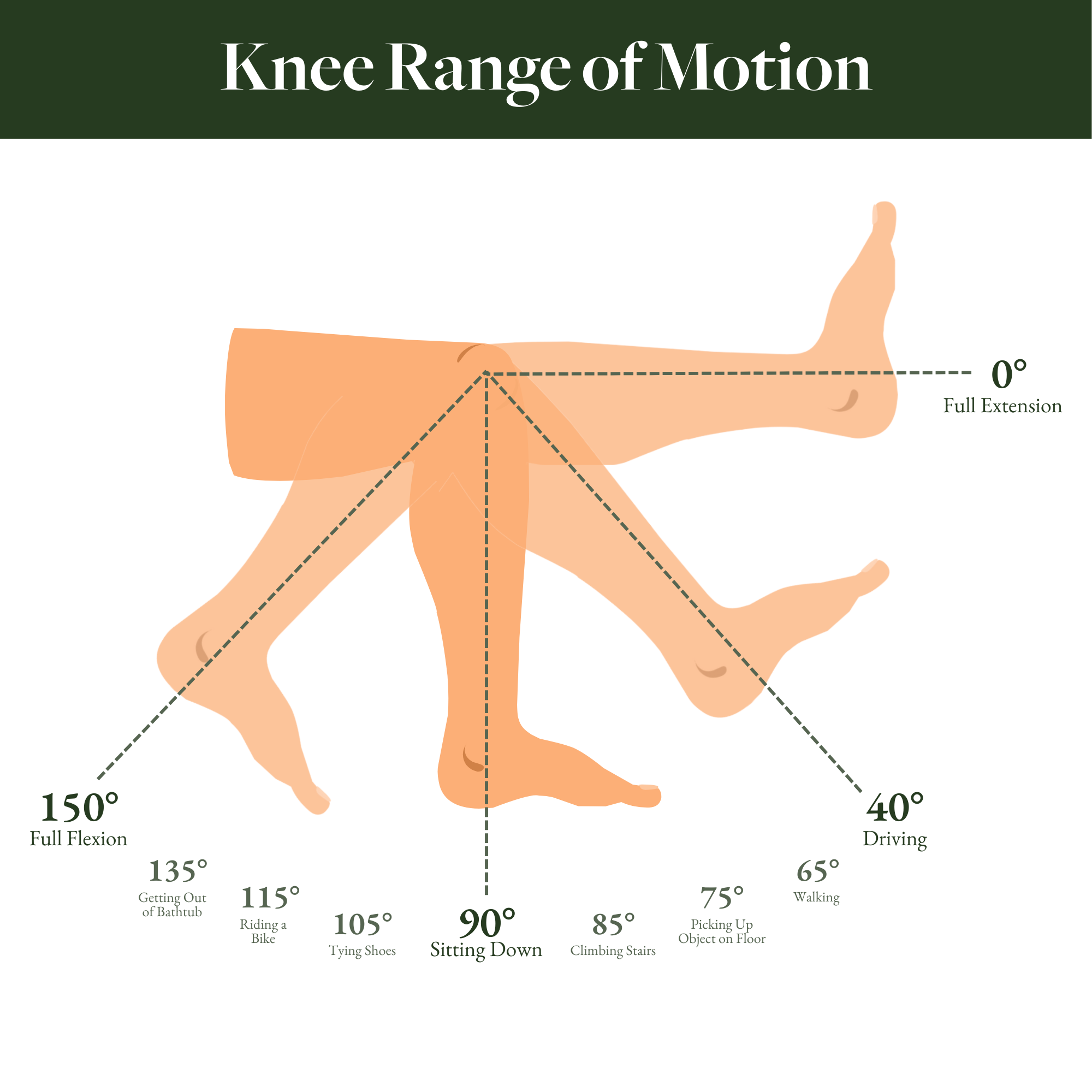
Flexion is the movement of bending of the knee, and limitation of flexion is the inability to fully bend the knee. VA rates limitation of flexion under diagnostic code 5260 based on the degree to which bending of the knee is limited:
30% - Flexion limited to 15 degrees
20% - Flexion limited to 30 degrees
10% - Flexion limited to 45 degrees
0% - Flexion limited to 60 degrees
Extension is the movement of straightening the leg at the knee joint, and limitation of extension is the inability to fully straighten the leg at the knee joint. VA rates limitation of extension under diagnostic code 5261 based on the degree to which straightening of the leg at the knee is limited:
50% - extension limited to 45 degrees
40% - extension limited to 30 degrees
30% - extension limited to 20 degrees
20% - extension limited to 15 degrees
10% - extension limited to 10 degrees
0% - extension limited to 5 degrees
VA may assign separate ratings for flexion and extension if both are compensable.
Knee Instability and Subluxation
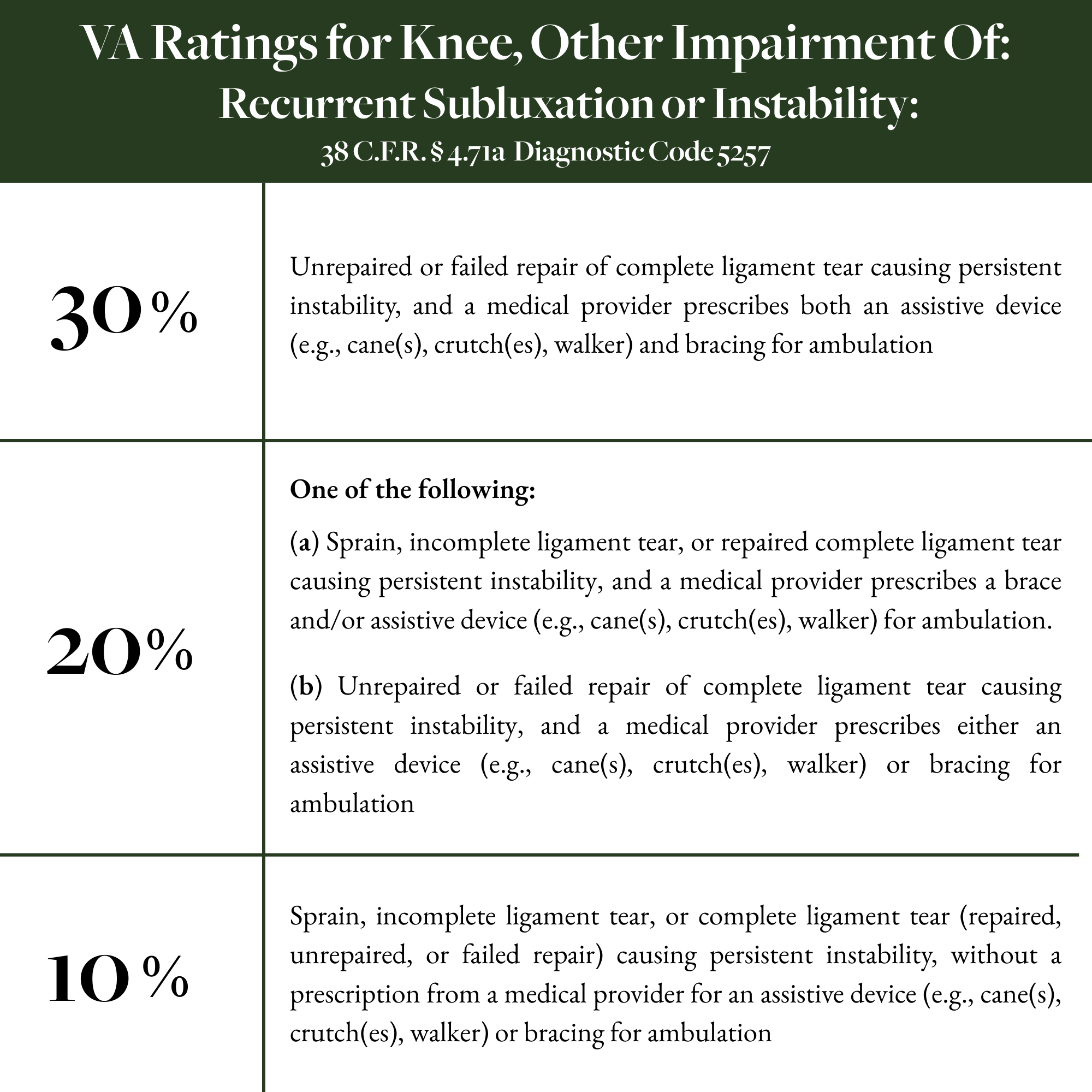
Rated under diagnostic code 5257. Knee instability is the feeling the knee is weak, loose, or might "give out." Subluxation of the knee is when the kneecap partially slips out of its normal groove on the thigh bone, often popping back in on its own, causing pain, instability, and swelling. Under diagnostic code 5257, ratings assigned for recurrent subluxation or instability are as follows:
20% - (a) Sprain, incomplete ligament tear, or repaired complete ligament tear causing persistent instability, and both an assistive device like a cane, crutches, or walker, and bracing for ambulation, have been prescribed by a medical professional, or (b) Unrepaired or failed repair of complete ligament tear causing persistent instability, and a medical provider prescribes either an assistive device like a cane, crutches, or walker, or bracing for ambulation.
10% - Sprain, incomplete ligament tear, or complete ligament tear (repaired, unrepaired, or failed repair) causing persistent instability, without a prescription for an assistive device like a cane, crutches, or walker, or bracing for ambulation.
30% - Unrepaired or failed repair of complete ligament tear causing persistent instability, and both an assistive device like a cane, crutches, or walker, and bracing for ambulation, have been prescribed by a medical professional.
Ratings for instability and subluxation can be assigned in addition to ratings for limitation and flexion.
Cartilage (Meniscus) Conditions
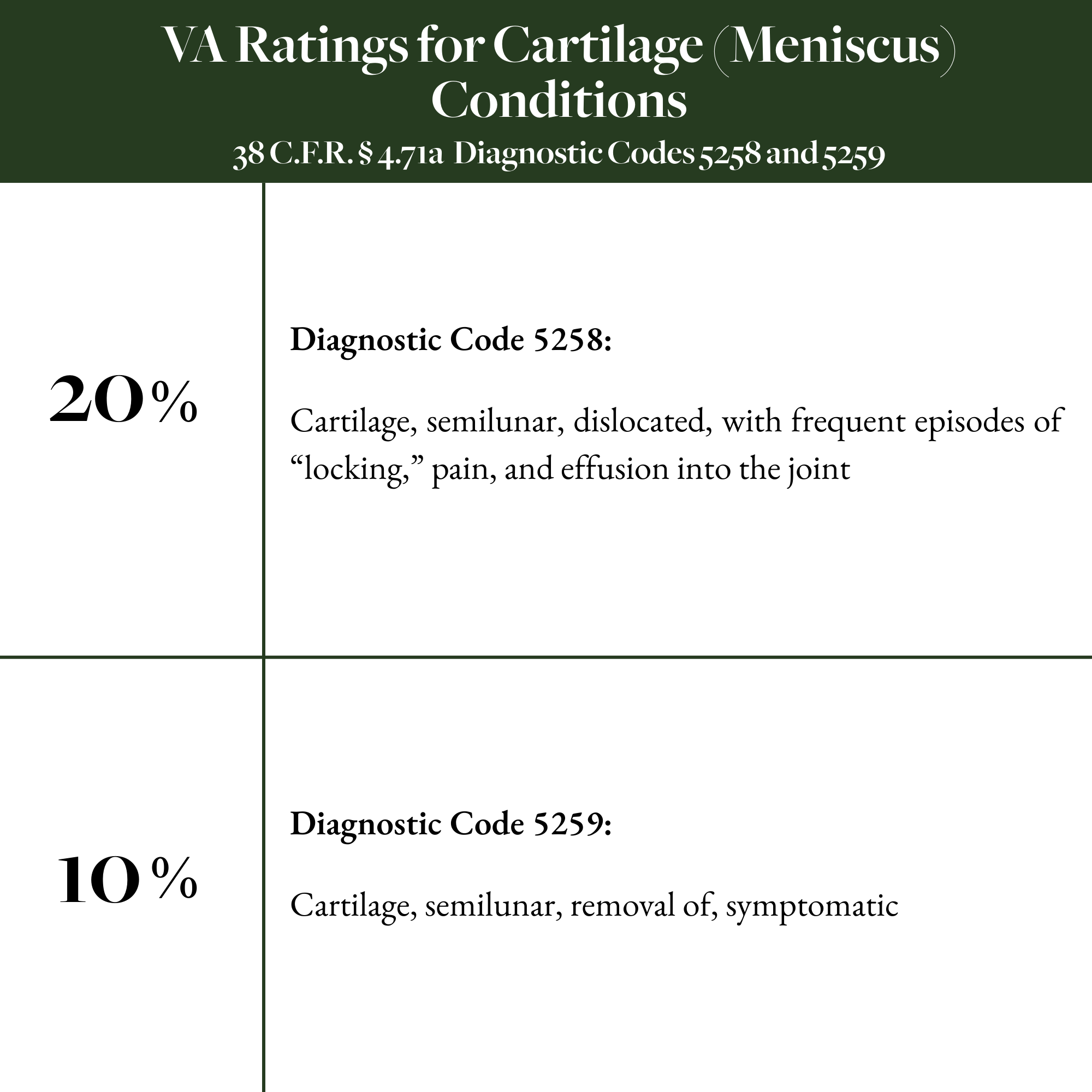
Rated under diagnostic codes 5258 and 5259 based on dislocation of the meniscus or removal of the meniscus.
20% - Cartilage, semilunar, dislocated, with frequent episodes of “locking,” pain, and effusion into the joint
10% - Cartilage, semilunar, removal of, symptomatic
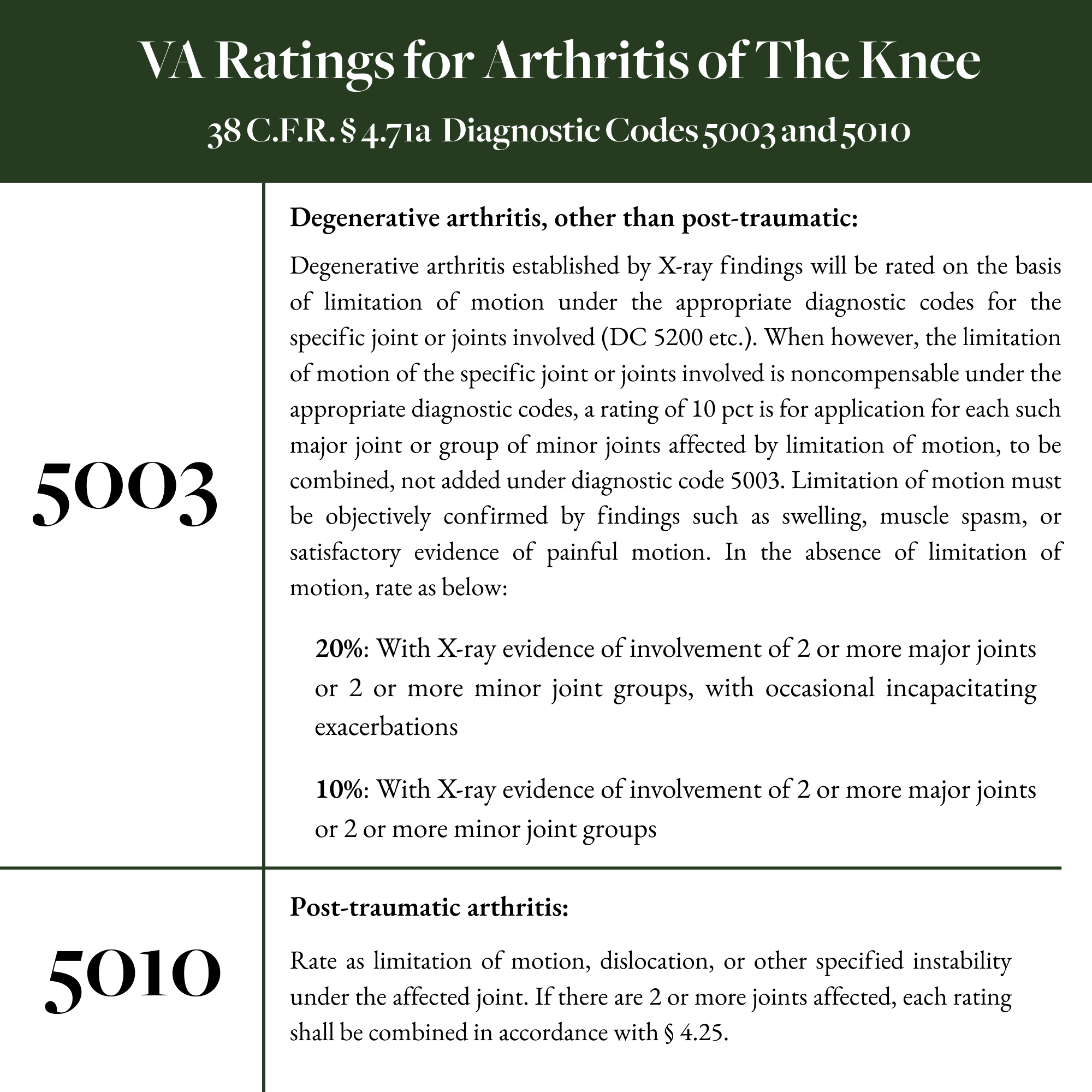
Arthritis of The Knee
Rated under diagnostic codes 5003 and 5010. Degenerative or traumatic arthritis is rated based on limitation of motion. When limitation is noncompensable, 10% may be assigned for painful motion confirmed by imaging. Painful motion alone can support compensation under 38 C.F.R. § 4.59, even when range-of-motion measurements appear “normal.”
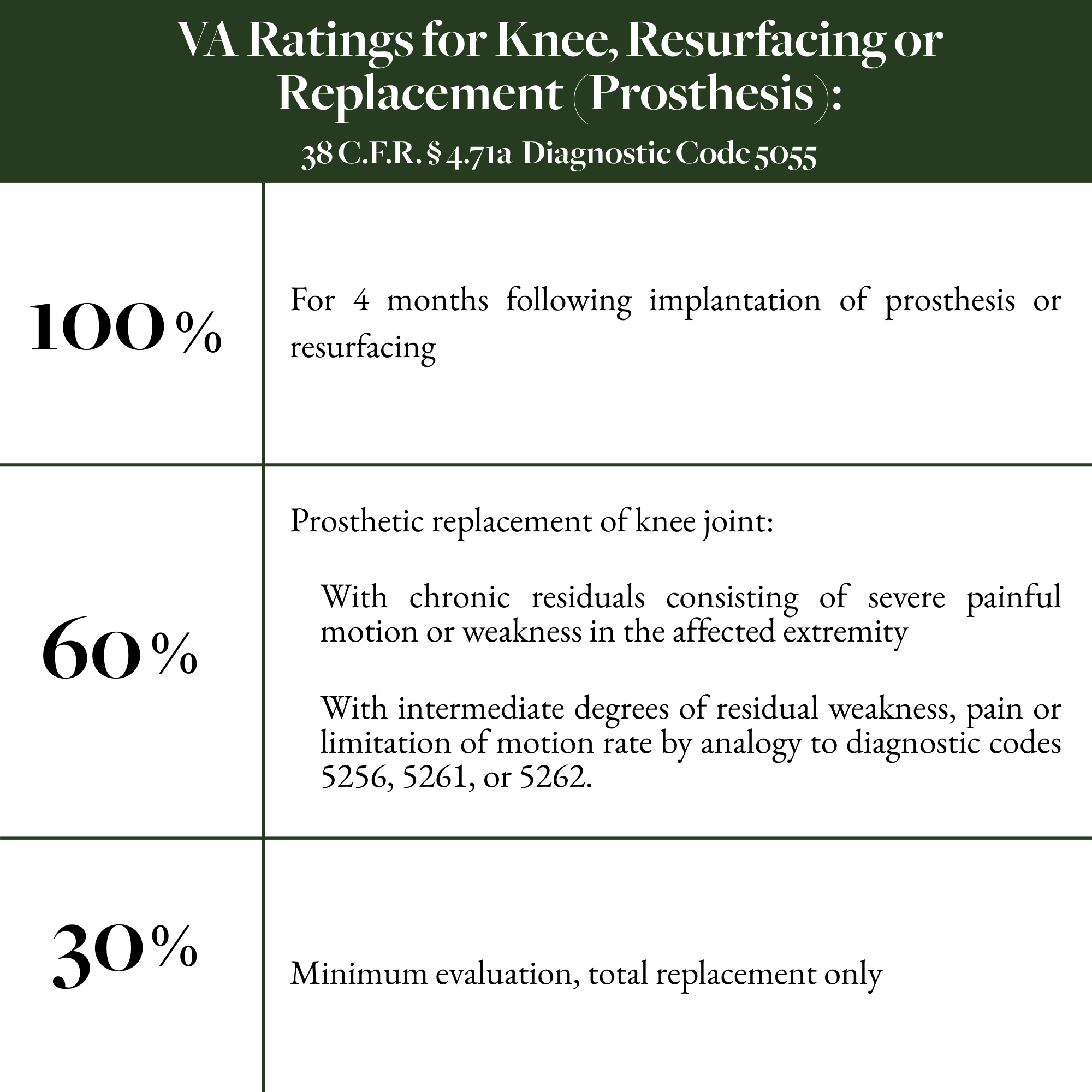
Total Knee Replacement
Rated under diagnostic code 5055. A 100% rating is assigned for 1 year following surgery. After the one-year period following surgery, ratings are assigned as follows:
60% - Prosthetic replacement of knee joint with chronic residuals consisting of severe painful motion or weakness in the affected extremity, or with intermediate degrees of residual weakness, pain, or limitation of motion rated by analogy to diagnostic codes 5256, 5261, or 5262.
30% - Minimum evaluation, total replacement only
VA evaluates knee disabilities using a combination of objective medical findings and functional impairment. To obtain a higher rating, the evidence must show that the knee condition has worsened or that VA did not adequately consider all compensable symptoms. The most common evidence sources include:
How to Increase a VA Knee Rating
C&P Examinations
Range-of-motion (ROM) testing for flexion and extension
Findings related to pain, weakness, fatigability, or incoordination
Functional loss during repetitive use testing
Flare-ups and their impact on motion, endurance, and stability
Evidence of instability, subluxation, or meniscal conditions
For knee conditions, the C&P examiner often conducts or reviews:
VA examiners use standardized Disability Benefits Questionnaires (DBQs) to document these findings.
The frequency and severity of knee pain
Flare-ups and how they limit standing, walking, bending, or weight-bearing
Instability, giving way, locking, swelling, or falls
The impact of the knee condition on daily activities and employment
Lay Evidence
Knee symptoms frequently fluctuate, and an examination performed on a “good day” may not reflect the veteran’s typical level of impairment. Lay testimony helps fill that evidentiary gap.
Lay statements are often critical in knee claims, especially where pain, flare-ups, or instability are not fully captured during a single examination. Veterans and witnesses can describe:
Ongoing orthopedic or primary care treatment notes
Imaging studies such as X-rays or MRIs
Physical therapy records
Surgical records, including arthroscopy or total knee replacement
Provider observations regarding functional limitations or worsening symptoms
Private treatment records can provide longitudinal evidence that VA examinations may miss. These records may include:
Private Medical Records
Providing complete private medical records can significantly strengthen a claim for an increased knee rating.
Higher-Level Review
Supplemental Claim with new and relevant evidence
Board Appeal
If VA issued a decision on the knee disability within the past year, a veteran may pursue review through:
Appeal and Review Options
Because knee ratings involve multiple diagnostic codes, functional loss analysis, and evolving regulations, many veterans benefit from professional representation when seeking an increased rating.
Knee Conditions and TDIU
Severe knee conditions may prevent substantially gainful employment, especially in jobs requiring prolonged standing or walking, physical labor, or repetitive bending, lifting, or squatting.
Veterans rated at 60 percent for a single disability, or with a rating of 70 percent combined with one condition rated at 40 percent or more, may qualify for TDIU.
Denied or Underrated for VA Knee Condition? Call Greene & Marusak LLC
VA knee claims are often underestimated, especially when pain, instability, or flare-ups are not fully considered. If VA denied or underrated your knee disability, Greene & Marusak LLC can help.
Contact us for a free case evaluation today to speak with an experienced VA-accredited claims agent or attorney.