

VA Rating Criteria for Hearing Loss & Tinnitus Explained

When VA grants service connection for hearing loss, it assigns a disability rating based on auditory test results (Puretone threshold average and speech discrimination percentage) for both ears. When VA grants service connection for tinnitus, it almost always assigns a maximum rating of 10 percent for recurrent tinnitus. These ratings determine a veteran’s monthly compensation and additional benefits. Because hearing loss often worsens over time, it is essential to file a claim for an increased evaluation to be reevaluated when you feel your hearing has worsened, to ensure the correct rating is assigned.
VA rates hearing loss as hearing impairment under 38 C.F.R. § 4.85 using the test result values for Puretone threshold average and percent of speech discrimination. Ratings fall at 0, 10, 20, 30, 40, 50, 60, 70, 80, 90, or 100 percent, depending on severity. Whether a veteran is service-connected for hearing loss in one or both ears also affects the rating assigned.
VA rates tinnitus under 38 C.F.R. § 4.87, Diagnostic Code 6260 and assigns a maximum 10 percent rating for recurrent tinnitus.
A veteran’s C&P exams and Puretone threshold and speech discrimination tests results are critical forms of evidence when seeking a higher rating for hearing loss.
Veterans with severe hearing loss may qualify for additional benefits, including Total Disability Based on Individual Unemployability (TDIU) or Special Monthly Compensation (SMC).
Bottom Line Up Front:
How Does VA Assign Ratings for Hearing Loss & Tinnitus?
VA evaluates tinnitus on whether it is recurrent or not, which is based on a veteran’s subjective report. VA evaluates hearing loss using objective medical testing.
The most common evidence sources include:
The C&P examiner must be a state-licensed audiologist
The examiner must conduct:
A controlled speech discrimination test (specifically, the Maryland CNC recording)
Puretone audiometry test in an isolated booth; measurements will be reported at the frequencies of 500, 1000, 2000, 3000, and 4000 Hz
Examination to be conducted without the use of hearing aids
Both ears must be examined for hearing impairment even if hearing loss in only one ear is at issue
C&P Exams and Auditory Testing
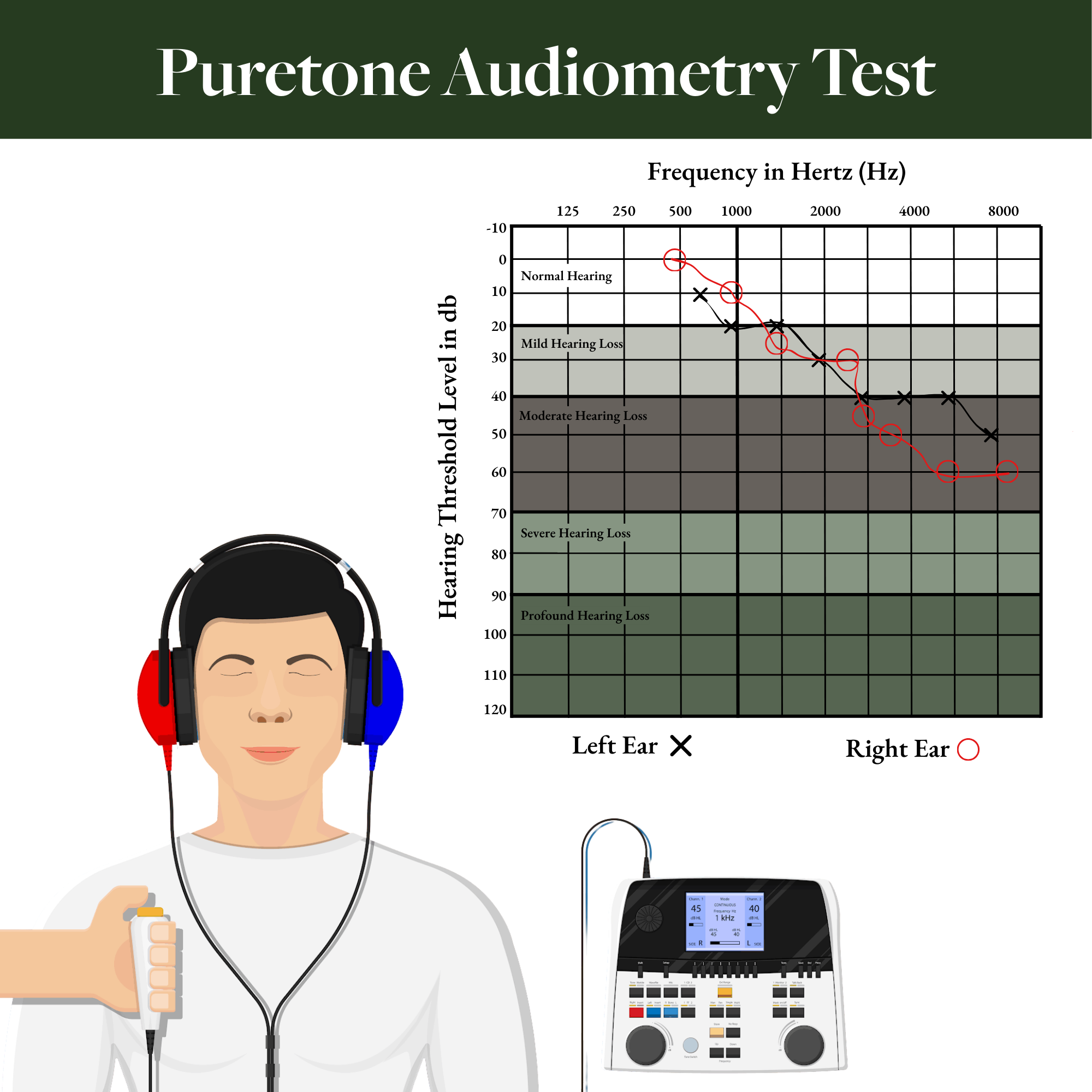
VA examiners complete a Hearing Loss and Tinnitus Disability Benefits Questionnaire (DBQ) to standardize the evaluation.
Lay statements can be useful to describe a Veteran’s experience of how their hearing has worsened and the functional limitations it poses. However, the rating is ultimately determined by auditory test results, usually performed during a C&P exam. A statement may help prompt reevaluation. Veterans and witnesses can describe:
Lay Evidence
The impact on daily life, including ability to work
Perceived worsening of hearing impairment
Audiologists may have records of auditory test results that would warrant a higher rating. Providing complete private records, but particularly auditory test results for the measures VA uses in rating hearing loss, can strengthen a claim. Veterans may also obtain private nexus opinions to link hearing loss or tinnitus to service.
Private Medical Records
How VA Rates Hearing Loss and Tinnitus (38 C.F.R. § 4.85)
VA uses diagnostic code 6260 for tinnitus, which provides a 10 percent rating for recurrent tinnitus. In some circumstances, VA may also assign a 0 percent rating for non-recurrent tinnitus (although VA may also simply deny service connection in such a scenario). 10 percent is the highest rating that may be assigned for tinnitus.
VA rates hearing loss using multiple tables provided in 38 C.F.R. § 4.85 to combine the Puretone threshold average and percent of speech discrimination values for each ear and then to combine those of each ear. First, VA uses Table IV to identify the Roman numeral corresponding to the combination of Puretone threshold average and speech discrimination percentage. If rating solely on Puretone threshold average, then Table IVA is used instead. Once the appropriate Roman numeral for each ear has been identified (if only service-connected in one ear, then the non-service-connected ear is assigned a Roman numeral value of I for rating purposes), Table VII is used to identify the corresponding rating for the combination of both Roman numerals, with the better ear represented in the vertical rows and poorer ear in the horizontal columns.
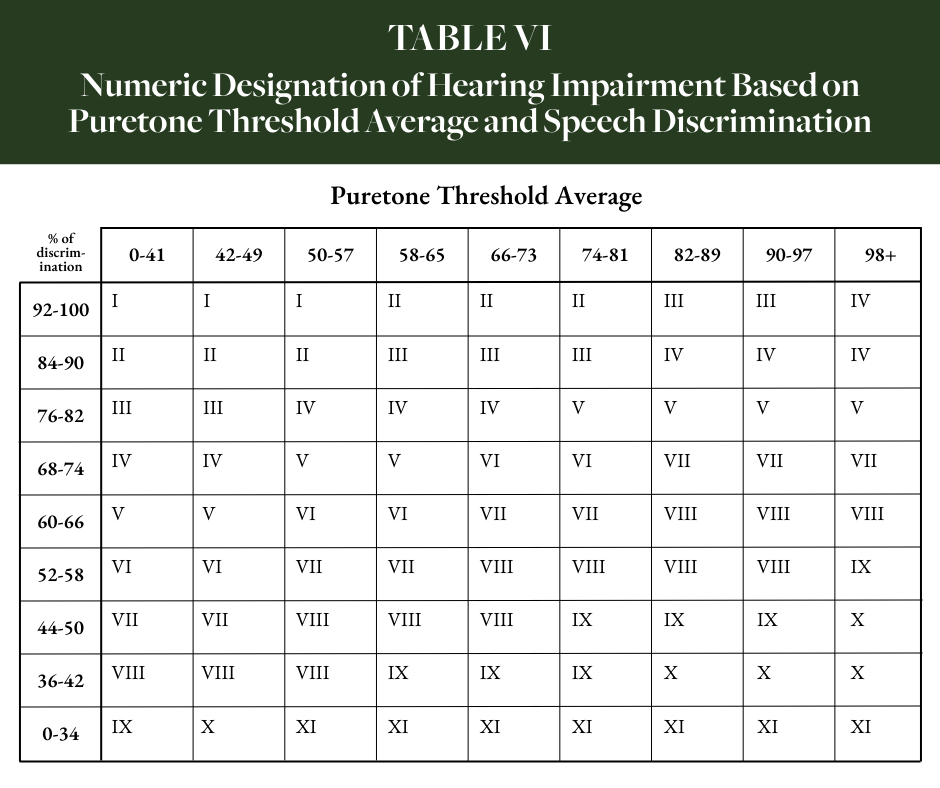
VA uses Table IV to identify the Roman numeral corresponding to the combination of Puretone threshold average and speech discrimination percentage
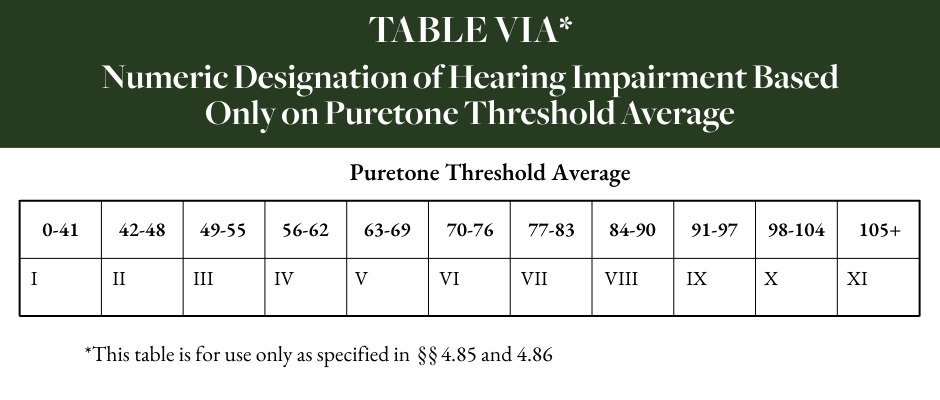
If rating solely on Puretone threshold average, then Table IVA is used instead.
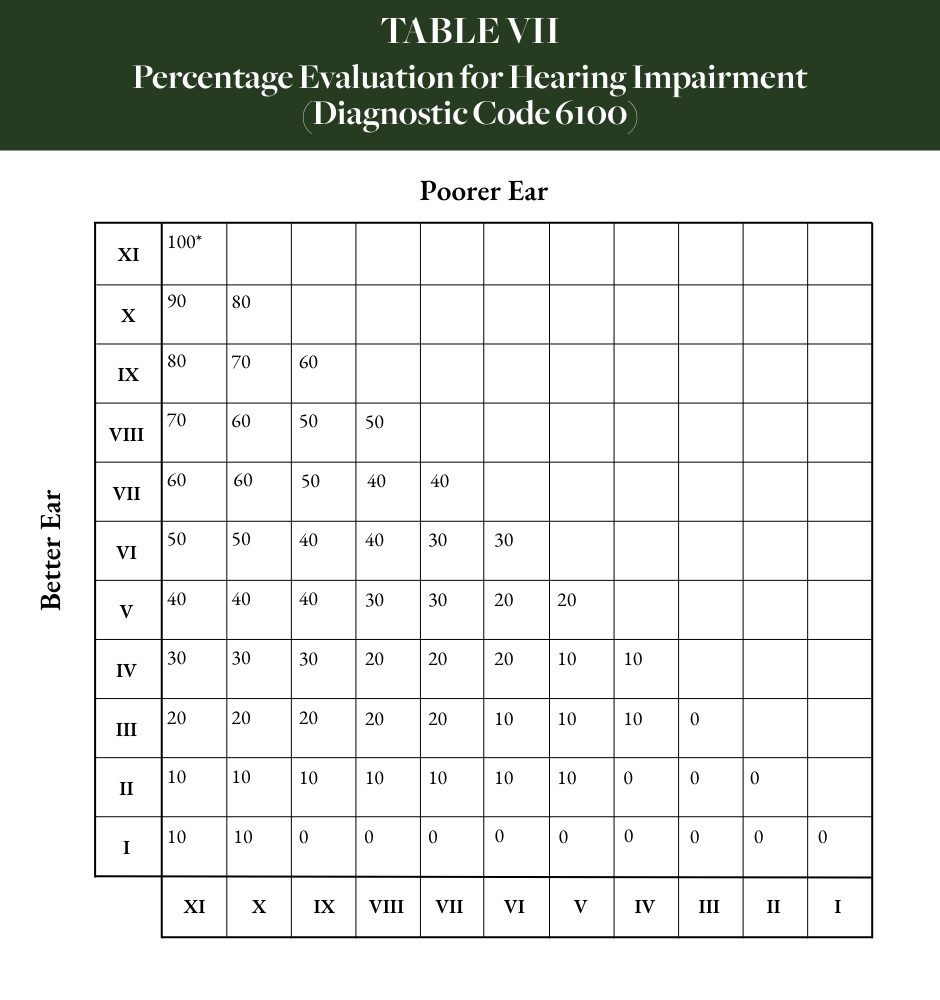
Once the appropriate Roman numeral for each ear has been identified, Table VII is used to identify the corresponding rating for the combination of both Roman numerals, with the better ear represented in the vertical rows and poorer ear in the horizontal columns.
Additional Factors Affecting Hearing Loss Ratings
Communication, especially for safety or accuracy
Noise perception, especially for safety
Severe hearing loss may impair a veteran’s ability to work, especially in jobs requiring:
Hearing Loss and TDIU
Veterans rated at 60 percent for a single condition (or 70 percent combined) may be eligible for Total Disability Based on Individual Unemployability (TDIU), providing compensation at the 100 percent rate.
If a 100 percent rating is assigned for hearing loss, VA must consider SMC. Deafness of both ears, having absence of air and bone conduction, warrants SMC(k). Severe hearing loss combined with other service-connected disabilities may create further eligibility.
Special Monthly Compensation (SMC)
How to Appeal or Increase a VA Hearing Loss Rating
Veterans may want to appeal or request an increase if:
VA denied service connection
VA underrated their hearing loss
Auditory test results worsen over time
Appeals can be filed through:
Higher-Level Review
Supplemental Claim with new and relevant evidence
Board Appeal
Because hearing loss ratings rely heavily on technical medical data, many veterans benefit from professional representation during appeals.
Denied or Underrated for VA Diabetes or Diabetic Complications? Call Greene & Marusak LLC
Hearing loss claims can be complex and may require detailed medical evidence, expert opinions, and strategic argument. If VA denied or underrated your hearing loss, Greene & Marusak LLC can help.
Contact us for a free case evaluation today to speak with an experienced VA-accredited claims agent or attorney!